
article
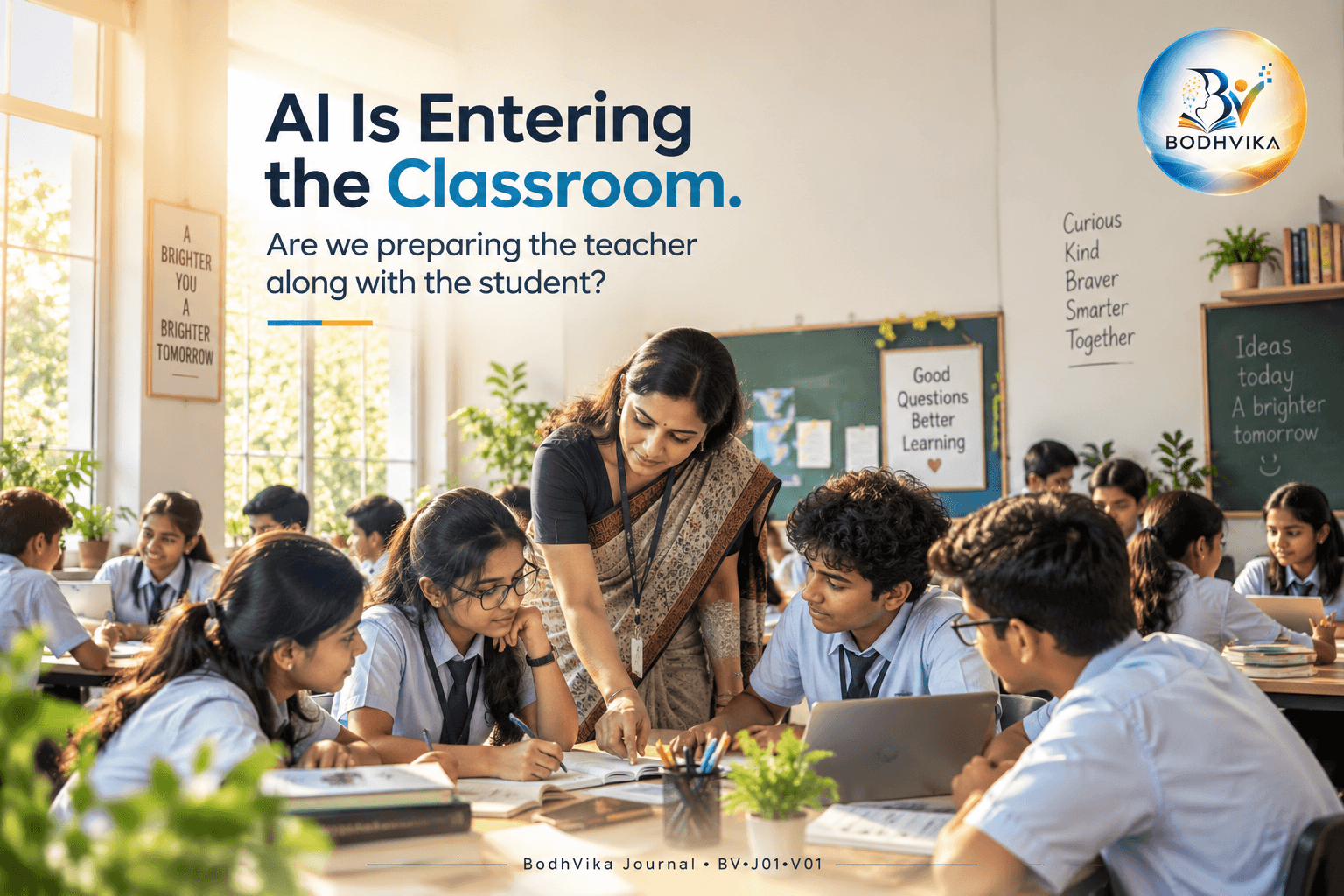
AI Is Entering Classrooms. Are Teachers Ready?
BodhVika · 17 September 2026 · 4 min read
BODHVIKA JOURNAL
ISSUE 01 • SEPTEMBER 2026
Published: 17 September 2026
"AI is no longer something education can discuss only as a future possibility. It is already changing how students find information, create work and approach learning."
That shift is now becoming visible in formal school education too. For the 2026–27 academic session, CBSE has introduced a Computational Thinking and Artificial Intelligence curriculum framework for Classes III–VIII, supported by resources for both students and teachers. [1][2]
But this raises an important question:
If students are being prepared for an AI-enabled world, are we preparing their teachers for it too?
"THE CLASSROOM IS CHANGING!"
Students can already use AI to explain concepts, summarise information, generate ideas and produce answers within seconds.
Teachers can use the same technology to plan lessons, create resources, develop questions and reduce repetitive work.
The challenge, therefore, is no longer simply access to information.
"It is judgement."
Is the answer accurate?
Did the student actually understand it?
Did AI support thinking — or replace it?
When does AI improve learning, and when does it get in the way?
These are educational questions before they are technological ones.
And that makes the teacher more important, not less.
USING AI IS NOT THE SAME AS UNDERSTANDING IT
A student can produce an impressive answer without understanding the concept behind it.
A teacher can generate a polished resource without knowing whether everything in it is accurate or appropriate for the learner.
AI can help us reach answers faster. But speed does not guarantee understanding.
That is why AI readiness cannot simply mean knowing how to use AI tools.
Students need to question, verify, reason and create.
Teachers need to know when AI genuinely supports learning — and when it does not.
Knowing how to generate an answer is useful.
Knowing whether that answer deserves to be trusted is education.
WHAT DOES AN AI-READY TEACHER NEED?
An AI-ready teacher does not need to become a technology expert.
Tools will change. Educational judgement will remain.
Teachers increasingly need to understand what AI can and cannot do, check AI-generated information, protect student thinking, recognise concerns around bias, privacy and responsible use, and decide where technology genuinely belongs in learning.
Sometimes the right decision will be to use AI.
Sometimes it will be to put it aside.
Knowing the difference matters.
STUDENTS NEED MORE THAN FASTER ANSWERS
The purpose of education cannot be to produce students who are simply better at obtaining answers.
It must develop people who can understand, question and evaluate them.
A student using AI to understand something difficult may be extending learning.
A student using the same technology to avoid understanding it may be weakening learning.
The technology can be the same.
The educational outcome is not.
So perhaps the better question is not simply:
“Did the student use AI?”
It is:
“What happened to the student's thinking because AI was used?”
SCHOOLS HAVE A ROLE TOO
Teachers and students cannot navigate this transition alone.
Schools will increasingly need thoughtful approaches to teacher development, student AI literacy, assessment, academic integrity, privacy, verification and responsible classroom use.
Moving quickly is not necessarily the goal - Moving intentionally is.
Technology should enter education because it serves a meaningful educational purpose — not simply because it is available.
THE FUTURE REMAINS HUMAN
AI will change parts of teaching and learning.
But as information becomes easier to generate, the human abilities surrounding information become even more important:
Curiosity.
Judgement.
Reasoning.
Creativity.
Questioning.
Empathy.
Understanding.
Preparing education for AI therefore means more than preparing students to use new technology.
It means preparing students to think, teachers to guide and schools to make responsible choices — together.
The future of education is not about choosing between teachers and technology.
It is about ensuring that technology strengthens the people and relationships that make learning possible.
Human First.
Learning Always.
Technology With Purpose.
REFERENCES
[1] Central Board of Secondary Education. Circular No. Acad-15/2026: Launch of CBSE Curriculum Framework for Computational Thinking (CT) and Artificial Intelligence (AI) for Classes III–VIII (Session 2026–27). 1 April 2026.
[2] Central Board of Secondary Education. Circular No. Acad-18/2026: Students' and Teachers' Resource Books for Computational Thinking and Artificial Intelligence (CT&AI) for Classes III–VIII. 9 April 2026.
BodhVika Journal • Issue 01 • September 2026
Independent educational perspectives on teaching, learning and technology.
© 2026 BodhVika. All rights reserved.
#AI in Education#Teachers#Students#Schools#Future of Education#AI Literacy